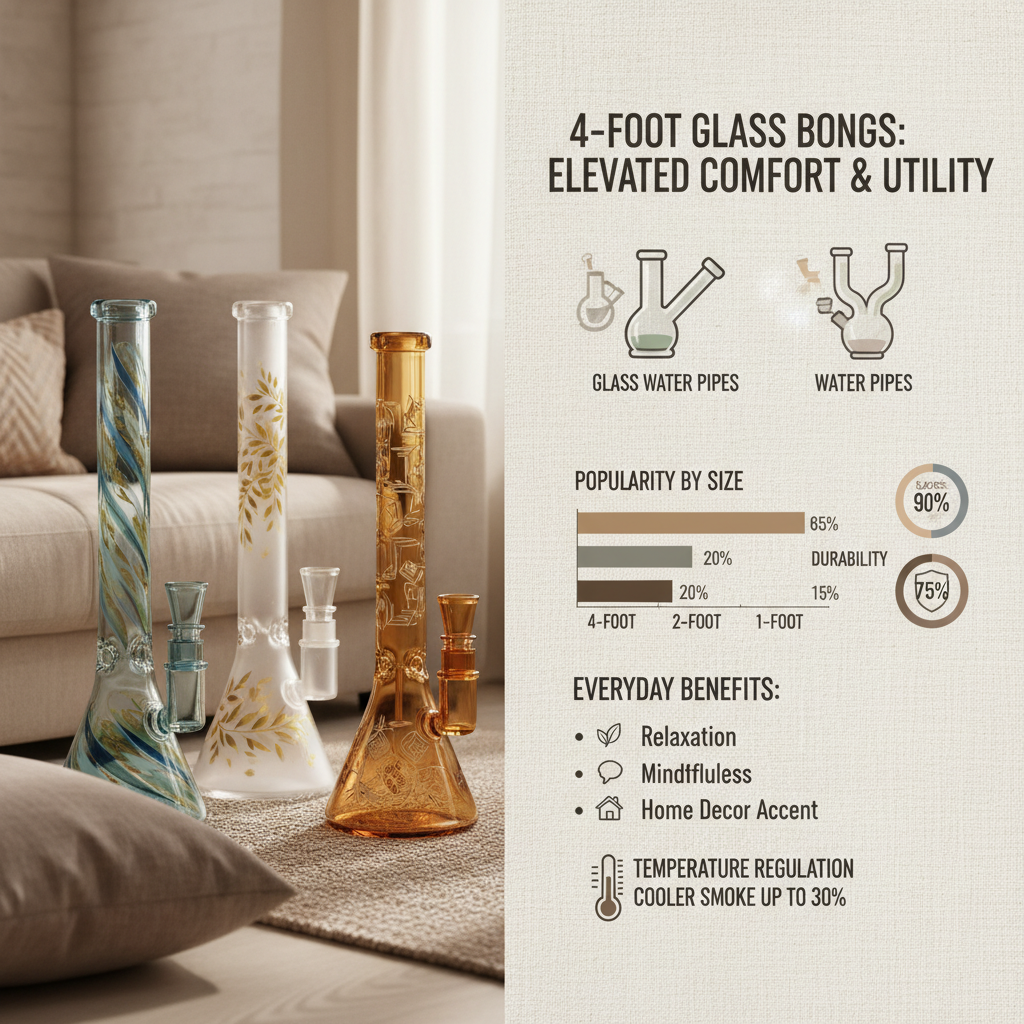
The market for high-quality smoking accessories has seen a significant shift toward larger, more efficient designs, with 4 foot glass bongs emerging as a preferred choice for enthusiasts seeking maximum filtration and cooling. By extending the distance the smoke travels, these larger vessels allow for a smoother experience, reducing the harshness often associated with smaller pieces.
Beyond mere size, the engineering of 4 foot glass bongs involves a delicate balance of structural integrity and thermal dynamics. Using premium borosilicate glass, these pieces are designed to withstand extreme temperature fluctuations while providing a voluminous chamber that optimizes air-to-smoke ratios, making them a staple in both luxury collections and functional daily use.
Understanding the nuances of these larger glass pieces is essential for any collector or manufacturer. From the thickness of the glass walls to the precision of the joint fittings, the technical specifications of 4 foot glass bongs dictate not only the aesthetic appeal but the long-term durability and performance of the product in a global market.
Engineering and Material Science of 4 Foot Glass Bongs
The production of 4 foot glass bongs begins with the selection of high-grade borosilicate glass, a material renowned for its low coefficient of thermal expansion. This ensures that the large surface area of the vessel does not crack under the stress of rapid heating and cooling, which is critical for pieces of this magnitude.
Precision blowing and annealing processes are employed to ensure uniform wall thickness. In a 4-foot structure, any inconsistency in the glass thickness can create "weak points," making the item susceptible to breakage during transit or use. Rigorous quality control ensures that each piece meets industrial standards for safety and longevity.
Thermal Dynamics and Smoke Cooling Efficiency
One of the primary advantages of 4 foot glass bongs is the sheer volume of air and water the vessel can hold. As smoke rises through the water and travels up the long neck, it undergoes a process of natural convection and heat exchange with the surrounding environment. This significantly lowers the temperature of the smoke before it reaches the user.
The cooling effect is proportional to the distance the smoke travels; therefore, the 48-inch height provides a superior cooling corridor compared to standard 12 or 18-inch pieces. This thermal reduction prevents throat irritation and allows for larger "hits" without the immediate discomfort of high-temperature vapors.
Furthermore, the large chamber allows for more efficient water percolation. When combined with advanced percolator designs, 4 foot glass bongs can break down smoke into thousands of tiny bubbles, increasing the surface area for filtration and further enhancing the cooling process.
Structural Stability and Durability Factors
Maintaining balance in 4 foot glass bongs is a significant engineering challenge. Due to their height, the center of gravity is shifted upward, requiring a wide, heavy-duty base to prevent accidental tipping, which is the leading cause of breakage in large-scale glassware.
To enhance the durability of 4 foot glass bongs, manufacturers often incorporate reinforced joints and thickened base glass. This "heavy-bottom" design not only provides stability but also ensures that the piece remains steady on various surfaces, from laboratory benches to home furniture.
Additionally, the use of professional-grade annealing ovens removes internal stresses from the glass. This process is vital for 4 foot glass bongs, as it ensures the molecular structure is stable, reducing the likelihood of spontaneous shattering due to atmospheric pressure changes or minor impacts.
Performance Metrics Across Different Designs
Not all large-scale vessels are created equal; the geometry of the tube significantly impacts the airflow and resistance. Straight-tube 4 foot glass bongs offer a direct path for smoke, providing a "punchier" hit, while beaker-base models provide more water volume for superior filtration.
When evaluating the efficiency of these pieces, users typically look at the balance between "drag" (the effort required to inhale) and "smoothness." High-end 4 foot glass bongs are engineered to minimize drag while maximizing the cooling period of the smoke.
Performance Efficiency of 4 Foot Glass Bongs Designs
Global Market Applications and User Demographics
The demand for 4 foot glass bongs spans various global regions, with high concentrations in North America and Europe, where glass art and functional smoking pieces are highly valued. In these markets, the focus is often on the intersection of utility and artistic expression, leading to the rise of "functional art" pieces.
Beyond the consumer market, large glass tubes and vessels are often used in specialized industrial or laboratory settings where high-volume filtration or chemical separation is required. The same borosilicate principles applied to 4 foot glass bongs are utilized in the creation of professional laboratory glassware, highlighting the versatility of the manufacturing process.
Maintenance Protocols for Large Scale Glassware
Maintaining the hygiene of 4 foot glass bongs requires a systematic approach due to their size. Standard cleaning brushes often cannot reach the bottom of the chamber, necessitating the use of specialized long-reach cleaning tools or the "ISO-salt" method, where isopropyl alcohol and coarse salt are agitated within the vessel.
Regular maintenance is crucial to prevent the buildup of resin, which can obstruct airflow and diminish the cooling efficiency of the glass. Because 4 foot glass bongs hold a larger volume of water, stagnant water can lead to bacterial growth if not changed daily, affecting both the taste and health of the user.
Expert advice suggests rinsing the piece with warm water after every session and performing a deep clean weekly. For the most delicate 4 foot glass bongs, using a soft-bristle brush is recommended to avoid scratching the interior surface, which could create micro-fractures over time.
Future Innovations in Borosilicate Glass Fabrication
The future of 4 foot glass bongs lies in the integration of automated glass-blowing technology and advanced materials. We are seeing a trend toward "hybrid" glass, where borosilicate is fused with silicon or other impact-resistant polymers to create pieces that are virtually unbreakable without sacrificing the purity of the smoke.
Digital transformation is also hitting the workshop. CAD (Computer-Aided Design) allows engineers to simulate the airflow of a 4-foot vessel before it is even blown, ensuring that the percolation is mathematically optimized for the smoothest possible experience. This reduces waste and increases the precision of the final product.
Sustainability is another key driver. New recycling programs for industrial glass are making it possible to create eco-friendly 4 foot glass bongs using reclaimed high-temp glass, reducing the carbon footprint of the manufacturing process while maintaining the same high standards of quality.
Comparative Analysis of Borosilicate Glass Fabrication Techniques for 4ft Vessels
| Fabrication Method |
Durability Score |
Thermal Resistance |
Cost Efficiency |
| Traditional Hand-Blown |
7/10 |
9/10 |
Medium |
| Mold-Assisted Blowing |
8/10 |
8/10 |
High |
| CAD-Precision Casting |
9/10 |
10/10 |
Low |
| Reinforced Base Fusion |
10/10 |
8/10 |
Medium |
| Eco-Reclaimed Borosilicate |
7/10 |
7/10 |
Very High |
| Hybrid Glass-Polymer |
10/10 |
6/10 |
Medium |
FAQS
The primary reason is the enhanced cooling and filtration. 4 foot glass bongs provide a much longer path for smoke to travel, allowing it to cool down significantly. This results in a smoother inhale and less irritation to the throat and lungs compared to smaller pieces.
While any glass is breakable, high-quality 4 foot glass bongs made from thick borosilicate glass and featuring a wide, weighted base are quite durable. The key is ensuring the piece is stored in a stable environment and handled with care during cleaning.
The most effective method is using a combination of 91% isopropyl alcohol and coarse salt. Pour the mixture into the bong, plug the openings, and shake vigorously. For the long neck of 4 foot glass bongs, we recommend using a dedicated long-reach bottle brush to remove stubborn residue.
The height doesn't change the chemical potency of the substance, but it changes the delivery. Because 4 foot glass bongs cool the smoke so efficiently, users can often take deeper, larger hits more comfortably, which may lead to a more intense perceived effect.
A beaker base provides more water volume and better stability, which typically means better filtration. A straight tube is more streamlined and offers less air resistance, providing a faster, "sharper" hit. Both are excellent, but beaker bases are generally preferred for those prioritizing smoothness.
Look for transparency in the material specifications and check for a uniform thickness in the glass walls. Authentic borosilicate glass is clearer and more resistant to thermal shock. Purchasing from reputable suppliers like www.dsglassbong.com ensures you receive laboratory-grade materials.
Conclusion
In summary, 4 foot glass bongs represent the pinnacle of functional glassware, combining advanced borosilicate engineering with the physical laws of thermal dynamics to provide an unmatched smoking experience. From their superior cooling capabilities and structural stability to the meticulous maintenance required to keep them pristine, these vessels are more than just tools—they are investments in quality and comfort.
As we look toward the future, the integration of CAD design and sustainable manufacturing will only further refine the efficiency and accessibility of these large-scale pieces. Whether you are a seasoned collector or a newcomer to the world of high-end glass, opting for a vessel of this scale ensures a level of smoothness and satisfaction that smaller alternatives simply cannot replicate. To explore our premium collection, visit our website: www.dsglassbong.com